Sri Lanka had long been high on my wish list—for its nature, culture, diversity, and the promise of both adventure and tranquility in a single journey. We booked a 15-night trip through a small, locally based travel agency in Sri Lanka, including a private driver to take us around the island.
It turned out to be a great formula, although some of our wishes and expectations were misunderstood. I wrote more about how it matched—or differed from—our expectations in a separate blog: “The Karen in Me.”
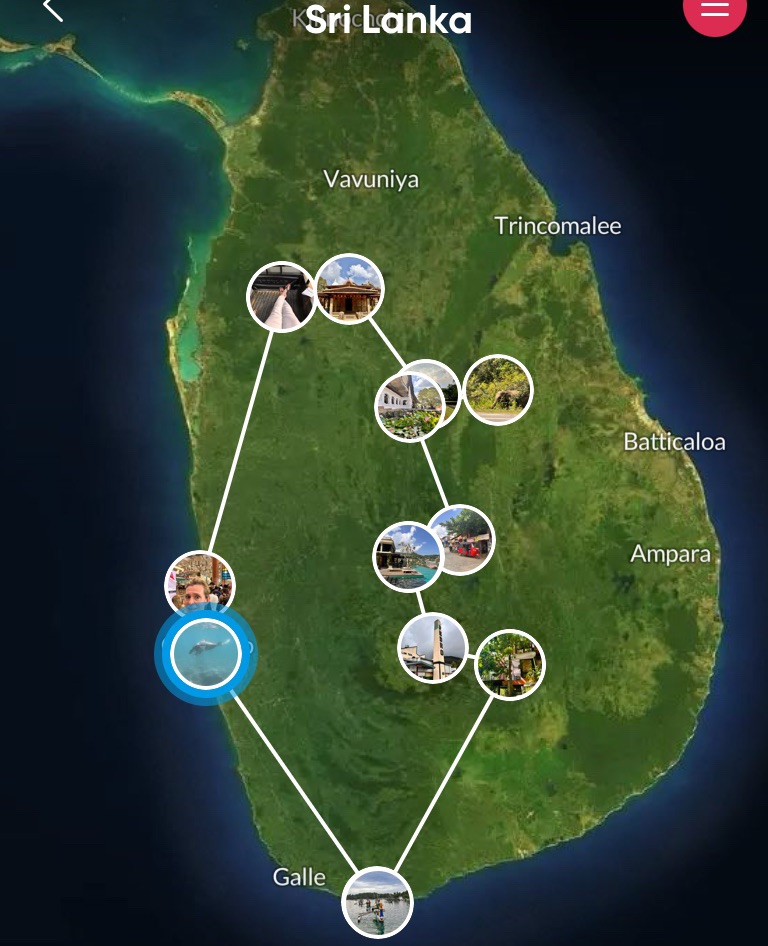
In short: The route we followed:
- Negombo (1 night) – for a gentle landing by the lagoon
- Wilpattu (2 nights) – safaris in the country’s largest national park
- Anuradhapura & Sigiriya (3 nights) – Polonnaruwa & Dambulla – ancient cities, royal rock fortresses, cycling, temples, and scorching stone paths
- Knuckles Mountains (1 night) – hiking, mist, and an unforgettable homestay
- Kandy (2 nights) – pilgrims, chanting, and a touch of luxury
- Nuwara Eliya & Ella (2 nights) –
tea fields, rain, and the most beautiful train ride ever - Polhena aan zee (3 nights) –
snorkeling, dolphins, and a relaxed ending - Colombo (1 night) – PoolBar on the Rooftop
A 9-Part Travel Journey
1. Start in Negombo
We land in Colombo on Good Friday. I only realize this when we find many places closed and pass an open-air mass crowded with people. Our journey begins in Negombo, where 95% of the population is Christian — the Mary statues are hard to miss. Negombo is an oasis by a calm lagoon. A little pool by the water, the sun high in the sky, and people so genuinely kind that I instantly slip into that perfect holiday state of mind.
In the evening, we take a short tuk-tuk ride to stock up on some supplies and have dinner under a starry sky, on our own little terrace overlooking the water.
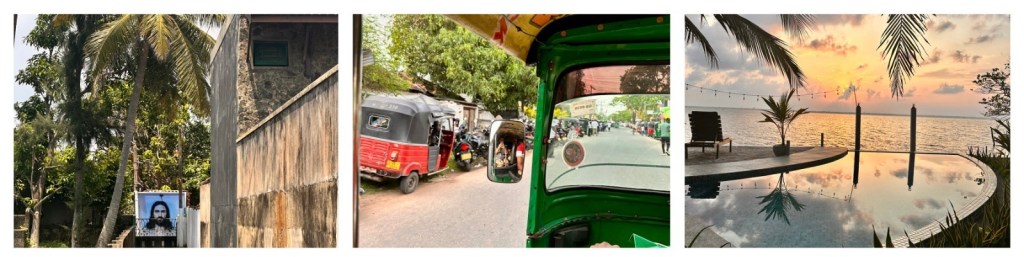
Accommodation: Hiru Lagoon Negombo – 10/10 (on the B&B scale: the atmosphere, the location, the host, the charm and the peace — AND the food).
Quick Facts
- Negombo is located about a 30-minute drive from Colombo Airport.
- Perfect for acclimatizing: lagoon, fish market, colonial influences.
2. Wilpattu National Park
After a delicious breakfast, we set off with our driver Ronnie towards Wilpattu. A four-hour drive through lush, forested greenery. Sri Lanka is stunning. Colour — so much colour. And everywhere, there’s a sense of peace and space. I also notice a lot of stone houses, more than in other Asian countries.
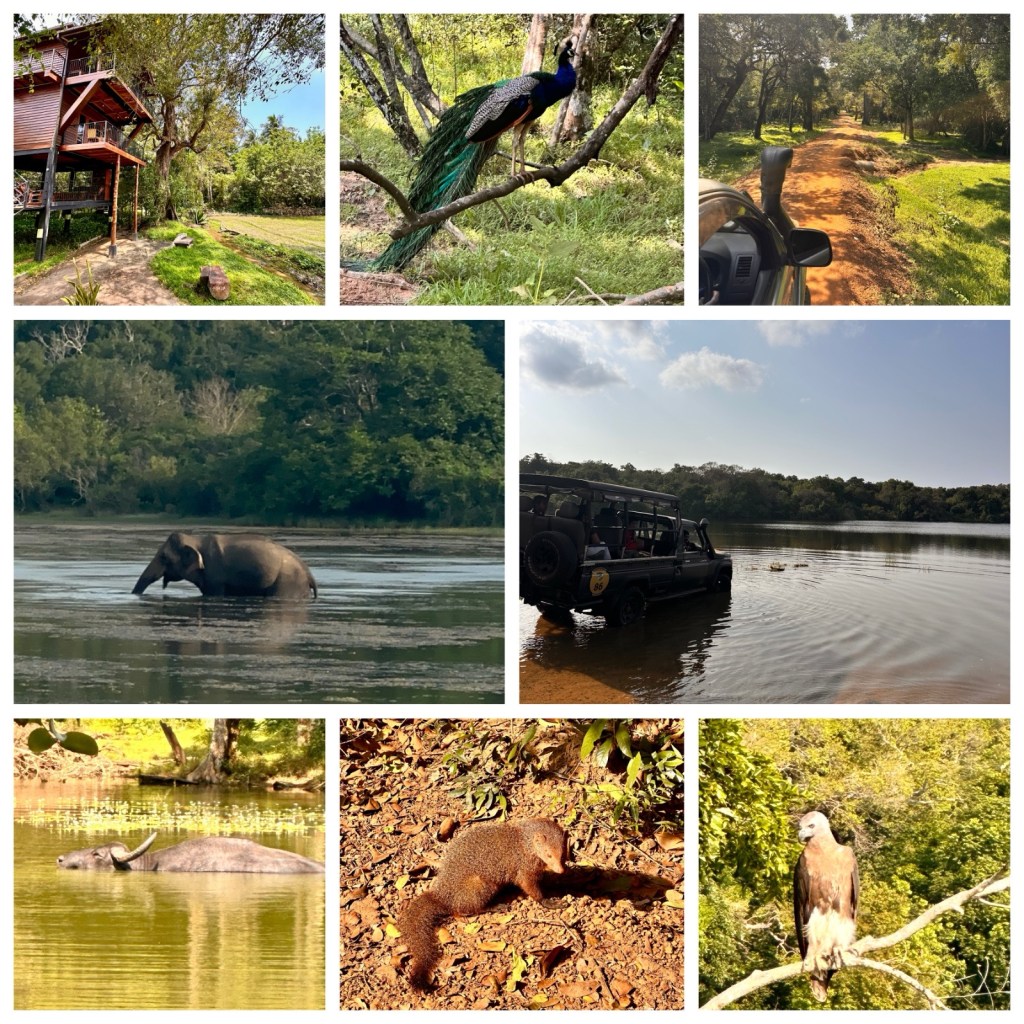
Our base for this safari stage is Wilpattu Tree House — complete with, yes, a real treehouse. Overlooking the rice fields, the hut gently sways with the breeze. Not everything is fully sealed off from nature, but the mosquito net does its job, and a curious gecko is simply part of the experience.
Early in the morning, we wake up to the sounds of the jungle orchestra. Coffee in hand, feet in the grass — and then, suddenly, it’s light.
We go on two safaris in the stunning Wilpattu National Park — one in the late afternoon and one at sunrise. We spot, among others, a sleeping sloth bear, an elephant, a golden jackal, possums, monkeys, crocodiles, birds of prey, and countless colourful birds — including the beautifully patterned hornbill. Our safari bingo card is almost full. Only the elusive leopard keeps its distance.
Between the safaris, we read on the terrace, watch the golden oriole and the Sri Lankan grey hornbill in the tree in front of our hut, and soak in the peace. The simplicity of the place, the silence of the surroundings, and the kindness of the people are truly heartwarming.
Accommodation: Wilpattu Tree House – 7/10 for comfort and maintenance (on the Lodge scale and price / quality).
Quick Facts
- Wilpattu is the largest national park in Sri Lanka (1,317 km²) and nearly twice the size of Singapore.
- Known for its leopards, sloth bears, elephants, and an impressive bird population.
- Best time to visit: February to October.
Tip: Bring binoculars — and make sure to empty your bladder beforehand!
3. Anuradhapura & Sigiriya
After one last look at the rice fields of Wilpattu, we head towards Anuradhapura, the first capital of Sri Lanka. A guide shows us around and explains that the city was built in concentric circles, aligned with the caste system: from the center outward. Its history dates back to 600 BC. Around 300 BC, Buddhism was introduced here from India. The city developed into a major spiritual center with a vast monastic complex and Buddhist schools. It was also here that the first writings on the teachings were recorded.
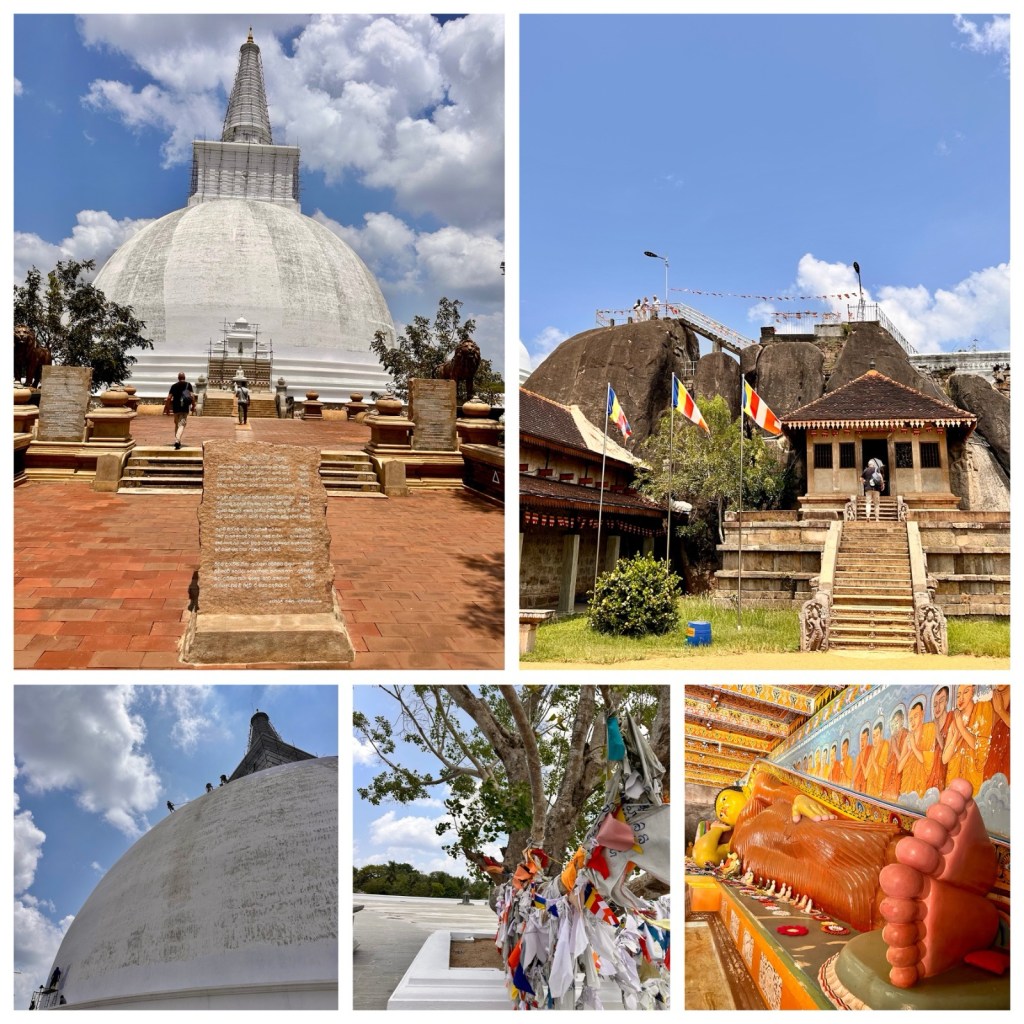
We begin at the Isurumuniya-tempel, built against a rock face. Further along, we walk a ritual circle around an immense, bright white stupa. In the scorching heat, painters dangle from ropes, dozens of meters high — no harness, no helmet. Different standards apply here.
A little later, we find ourselves face to face with a remarkable tree at the temple: a descendant of the original Bodhi Tree under which the Buddha attained enlightenment. It was planted in 236 BC — and it’s still alive today.
After a morning full of history, we continue on to the centre of Sigiriya. Ronnie has planned a traditional lunch in a “village,” but once we arrive, it turns out “traditional” mostly means: ox cart ride, handicraft show, wooden boat, and tourist buffet. We politely but firmly decide: not for us. Instead, we settle at an alternative restaurant — still touristy, but unfortunately serving the least tasty meal of the entire trip.
Our next overnight stay is aptly named Jungle Hut. We bounce along a bumpy dirt road into the middle of nowhere. A small oasis awaits: a little pool with a view, swaying trees, silence. Just in time, we jump in before a tropical thunderstorm breaks loose. The power briefly goes out, and the Wi-Fi doesn’t return for the rest of our stay. Oh well — there are worse things.
Sigiriya Rock Fortress
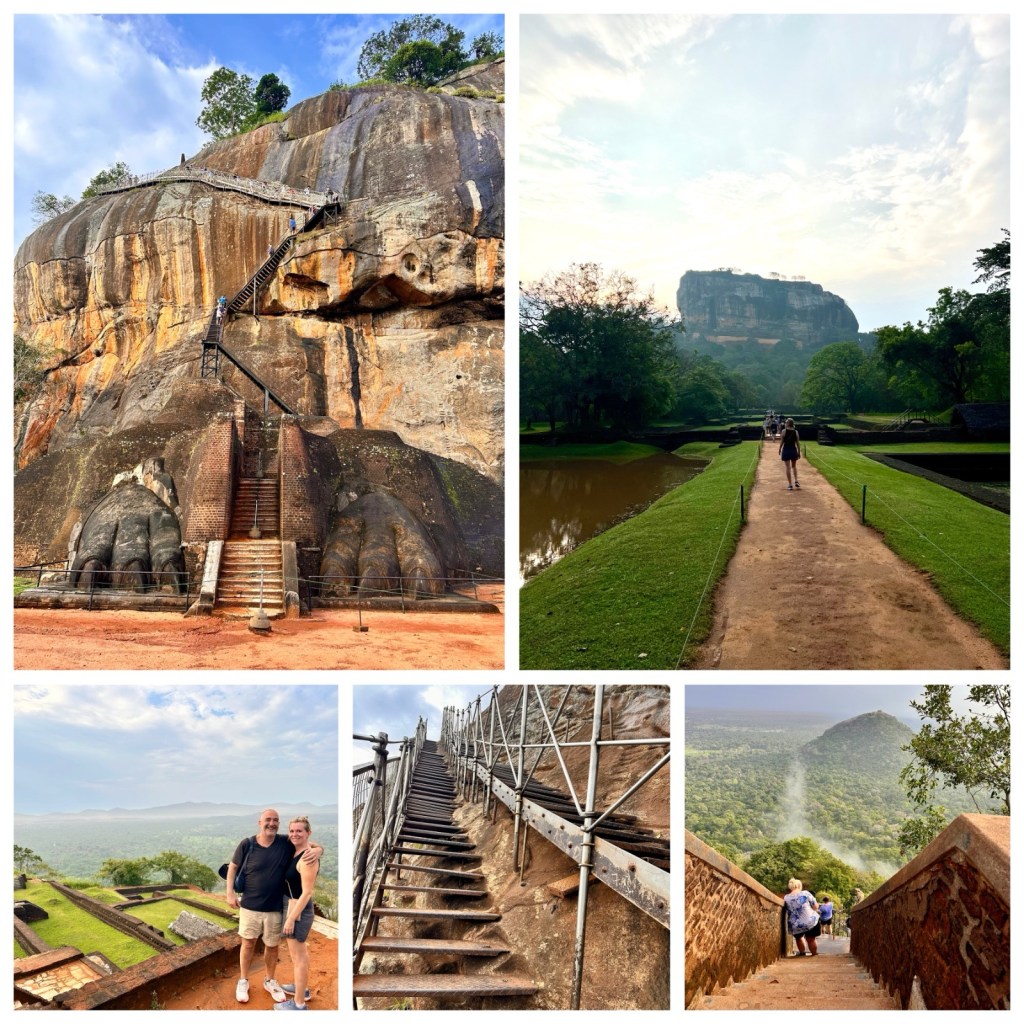
The next morning, we get up early to climb Sigiriya Rock Fortress (also known as Lion Rock) — a massive rock that once served as a monastery and later a royal palace. We ascend more than 45 floors via staircases and narrow metal walkways. With even a hint of vertigo, it’s a bit of a thrill, but the view is more than worth it: lush gardens, water features, and endless greenery.
In the afternoon, we enjoy an Ayurvedic massage and a herbal steam bath. Great for the legs — and just as good for the mind. The curry at dinner is mild, smooth, and beautifully spiced — different from Indian curry, with less sauce and more subtlety.
Accommodatie: Jungle Hut Sigiriya – 7/10 (on the scale of lodge) for the beautiful garden, atmosphere, and food. The room and terrace could use an upgrade (the shower is basic, not exactly spotless, and there’s no mosquito net or Wi-Fi).
Note: This location is quite remote; the last 10 minutes are along a bumpy dirt road that can be difficult to navigate in the rain.
Quick Facts
- Anuradhapura was the capital of Sri Lanka from the 4th century BC to the 10th century AD.
- The first written recording of the Buddha’s teachings took place in Anuradhapura. Around 100 BC, at the Aluvihara Monastery near Anuradhapura, the Buddhist scriptures (the Pali Canon) were written down on palm leaves for the first time — to preserve the oral tradition during a time of unrest.
- The sacred Bodhi tree here is over 2,200 years old.
- Sigiriya Rock Fortress dates back to the 5th century, featuring frescoes, bathing pools, and a throne at the summit.
- Best time to climb: early in the morning, before the heat sets in. Afraid of heights? Consider skipping the final stretch to the top.
4. Polonnaruwa & Dambulla
We leave early for Polonnaruwa, one of Sri Lanka’s ancient royal cities. Along the way, we’re treated to a surprise: a young elephant casually strolls out of the bushes by the roadside. Pure magic.
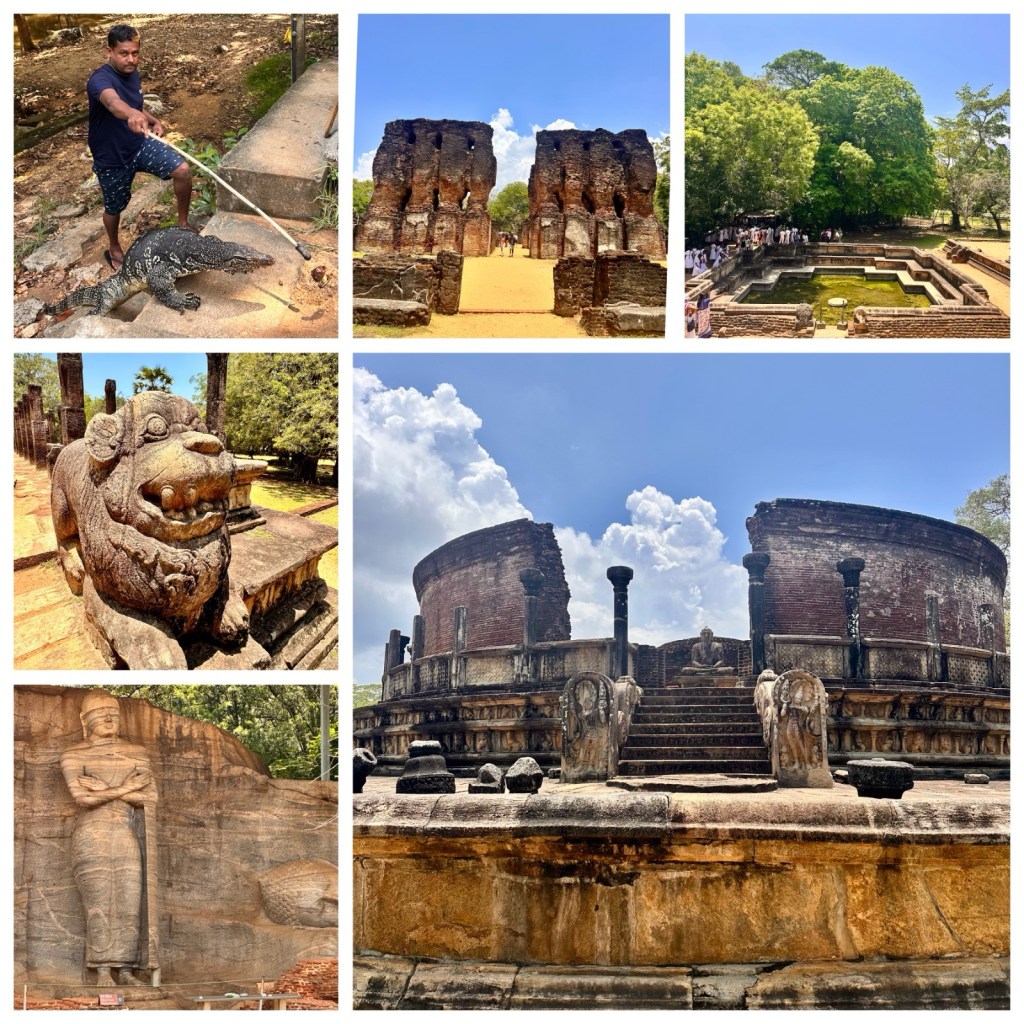
A little further on, Ronnie stops by a small river and tells us to get out. A man with a stick — and a fish head attached to it — lures a giant Asian water monitor out of the water. It feels like a tourist show, and it’s a bit uncomfortable. But the animal itself is undeniably impressive.
Among the ruins of Polonnaruwa, we hop on bikes — a welcome bit of movement after so much time in the car. We cycle across the grounds where the powerful King Parakramabahu once ruled (from 1153 to 1186 AD). His Royal Palace (Vejayanta Prasada) is said to have had seven storeys, of which two are still visible today. Construction took seven years — a lucky number. He had five wives and a harem of 300, but no children. According to our guide, he was a good king.
We cycle past temples and stupas that house relics of the Buddha. The heat is intense — 38 degrees — and temple grounds must be entered barefoot. My soles aren’t quite up to the task.
The entire area is impressive. For centuries, the ruins lay hidden beneath the ground and jungle. It wasn’t until the British arrived that the value of this site was recognized and excavation began. Even today, around 70% of the original city remains buried under soil and vegetation.
Dambulla
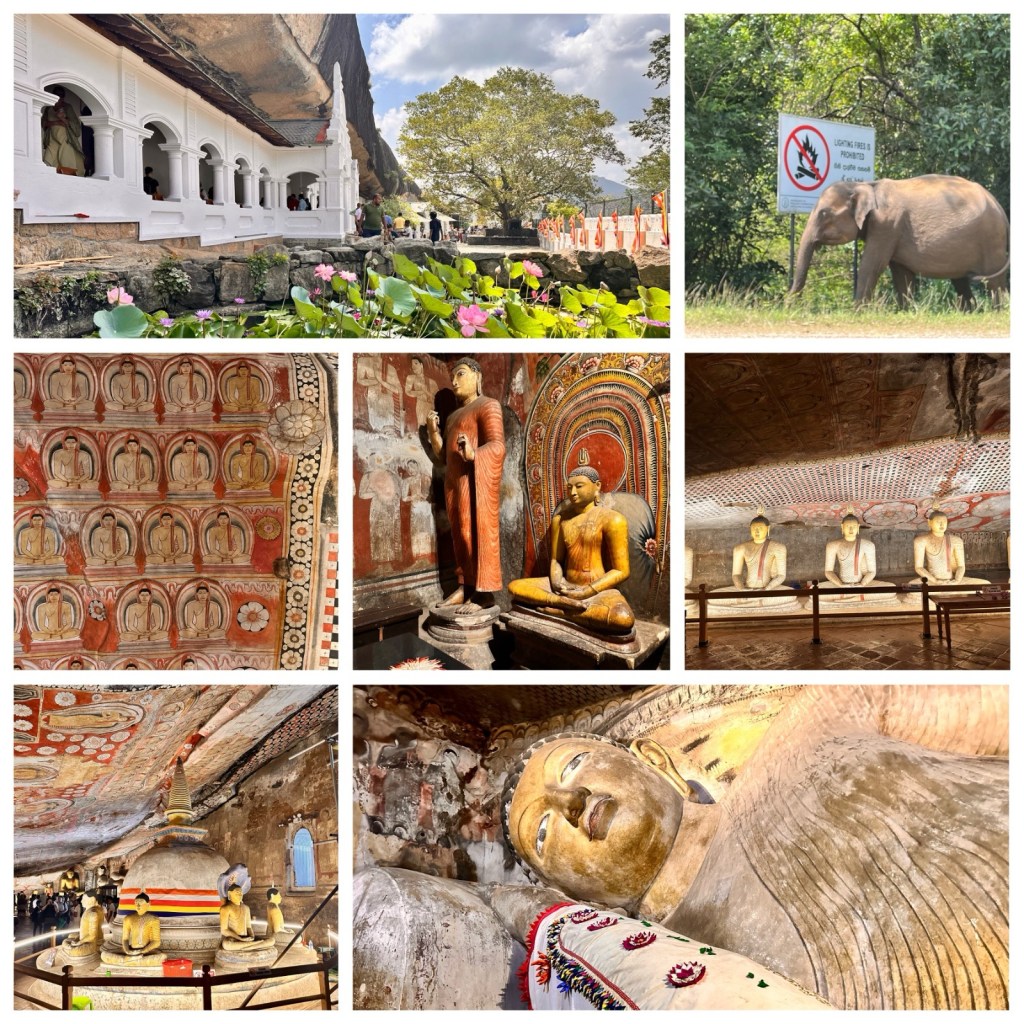
The next morning, it’s time for Dambulla. This cave temple complex is truly stunning. Built in the 1st century BC, it features wall and ceiling paintings covering more than 2,100 m². Each temple chamber feels like a time capsule — filled with serene statues and sacred silence.
On the way to our next destination, we make the inevitable stop at an Ayurvedic herb garden. A 74-year-old guide enthusiastically explains how everything works. There’s no obligation to buy — but of course, it’s expected. I usually try to avoid these tourist traps, but here I am, caught in one again.
Het reizen met een privéchauffeur was voor ons een verademing. Het gaf ons de vrijheid om de reis onderweg te tweaken en tunen naar ons eigen tempo en gevoel. De afwisseling van cultuur, stad, natuur en zee was heel prettig en goed in balans. Fijn ook dat we niet elke dag hoefden te reizen, waardoor er ruimte was om indrukken echt te laten landen.
Quick Facts
- After the fall of Anuradhapura, Polonnaruwa became the new capital of Sri Lanka in the 11th century. It flourished under King Parakramabahu I (1153–1186), who was known for his vision and impressive infrastructure.
- According to chronicles, his palace — known as the Vejayanta Prasada — had seven storeys and over 1,000 rooms. Today, mainly the impressive foundations and walls remain, rising up to about three storeys high.
- In the 13th century, Polonnaruwa fell into decline following invasions from South India and a shift in royal power. The city was abandoned and gradually reclaimed by the jungle, until it was rediscovered and excavated centuries later.
- The Golden Temple of Dambulla (also known as the Dambulla Cave Temple) consists of five caves filled with more than 150 Buddha statues and colourful wall paintings. The oldest statues date back to the 1st century BC.
- In the 1st century BC, King Valagamba took refuge in these caves after being temporarily overthrown. When he later regained power, he had the caves transformed into a Buddhist sanctuary — as an act of gratitude.
Tip: Cycling is a joy and offers some relief from the heat. Bring socks for the scorching temple floors, and carry a shawl in your bag for entering sacred sites.
5. Knuckles Mountains
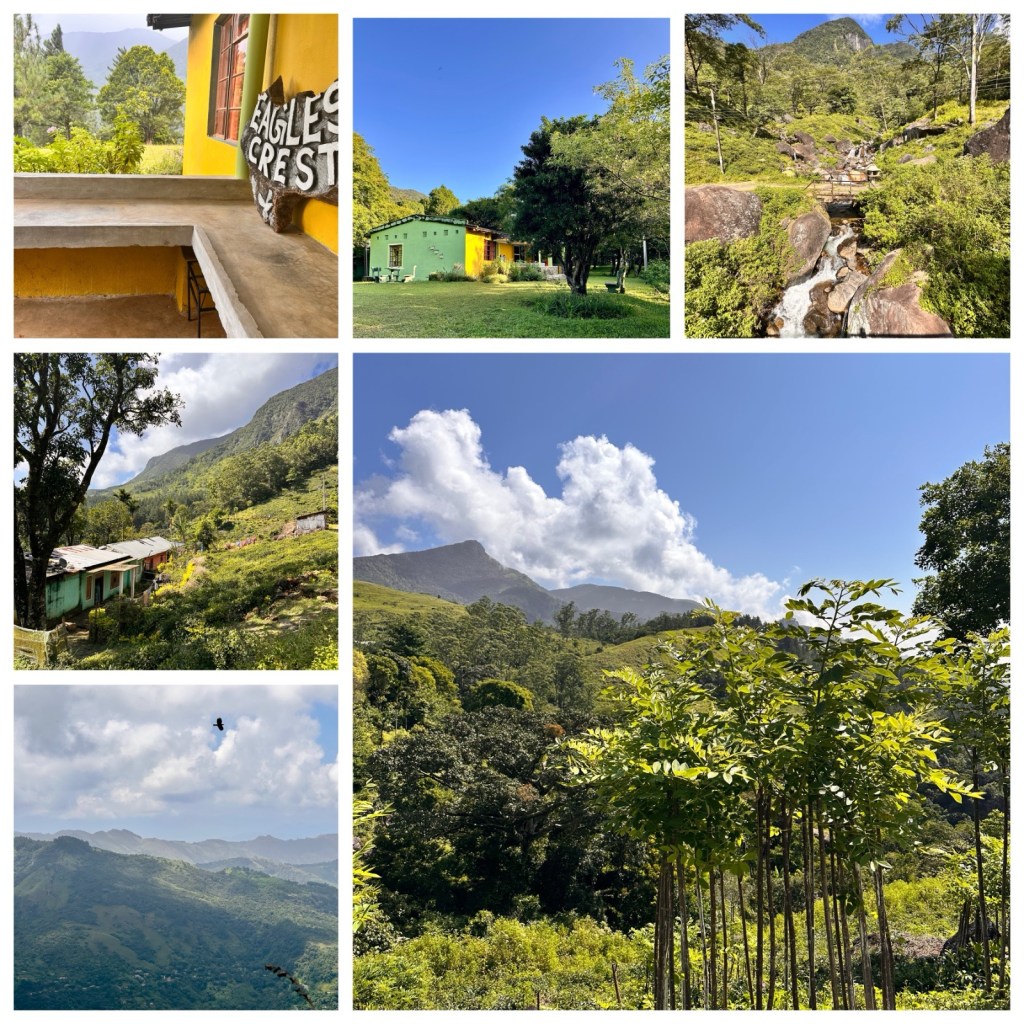
We leave the lowlands behind and wind our way into the mountains, heading towards the Knuckles Range. The landscape begins to shift — everything turns greener, mistier, fresher. Tea plantations cling to the hillsides, waterfalls tumble down rocky cliffs, wisps of cloud drift between the peaks. And then suddenly: a giant Buddha statue rising out of nowhere above the valley.
Upon arriving at Knuckles Lodge Eagle Crest, it turns out Ronnie can’t make it up the steep, slippery road. Our host Sid — friendly, articulate, and clearly no stranger to logistical challenges — comes to meet us. Before long, we’re in another vehicle, on our way to his place tucked deep in the mountains.
Sid turns out to be not just our host, but also our guide, dinner companion, and hiking buddy. Upon arrival, he immediately takes us on a walk through the hills, past tea fields, to a small hut where we have tea and some snacks. And then I feel it — something slippery on my foot. A leech. Ugh. It’s already done its job; the blood is pouring out.
The lodge is simple but full of charm. We share a meal with Sid, who feels like an old friend, all while he gives his energetic and funny little son the attention he needs. The pace is slow, the atmosphere homely and familiar.
The next morning, we set off on a long hike to Mini World’s End, a viewpoint offering panoramic views of the mountains. We walk through tea fields, along deserted paths, across muddy tracks. Once again, that soft mist that quiets everything. We climb, take in the views, breathe. And pick leeches off our shoes before they get a chance to latch on.
Back at the lodge, a generous home-made lunch awaits: jackfruit curry (smoky and meaty in flavour) and tiny fried fish that remind us of sprats. Everything fresh, everything prepared with care and love.
Quick Facts
- The Knuckles Mountain Range (UNESCO) is located in central Sri Lanka and gets its name from its resemblance to a clenched fist.
- It’s a beloved hiking area with rich biodiversity — from orchids to monkeys.
- Leeches are common, especially after rain. Due to the anticoagulant they release, the bleeding tends to go on for quite a while.
- Mini World’s End offers a spectacular viewpoint in clear weather.
Tip: Bring sturdy hiking shoes for the trek. And leech socks and mosquito repellent are far from a luxury — they’re essentials.
Accommodatie: Eagle Crest Mountain Lodge – 10/10 for the authentic experience and stunning nature — as long as you’re prepared for a true back-to-nature stay. Note: You’re genuinely a guest in someone’s home here. Don’t expect much privacy: no closed-off bedroom, just a curtain, a hard bed, a basic shower, and plenty of creatures you might encounter both outside and inside.
6. Kandy
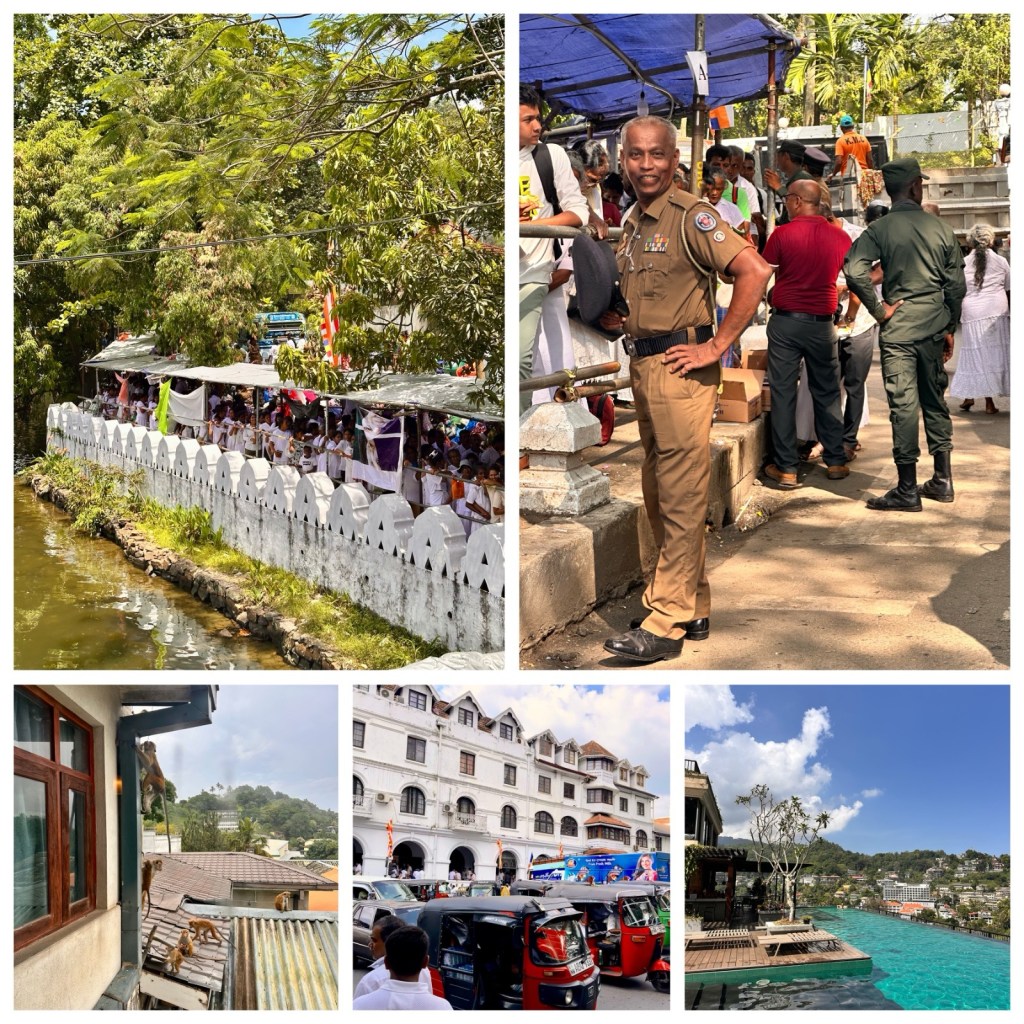
We say goodbye to the mountains and drive to Kandy, the cultural capital of Sri Lanka. Our expectations are mixed: a major religious festival has just begun, and for the first time in sixteen years, the sacred Tooth Relic of the Buddha is being displayed to the public at the Sri Dalada Maligawa. Tens of thousands of pilgrims are flooding into the city, and in the first few days, the queue stretches as long as 7 kilometres.
Thankfully, our hotel is on the right side of the lake, and we reach it without too much delay. What a relief: a truly soft bed, a hot shower with proper pressure, and a bathroom door that actually closes. The Wi-Fi works, the pool is beautiful — and on our balcony, curious monkeys put on a show. One even presses its nose flat against the glass.
We take a short walk towards the city centre. The crowd is immense. Kilometres-long lines, most people dressed in white, patiently waiting for a glimpse of the relic. Juices, rice balls, and water are being handed out — even to us. We politely decline, but the atmosphere is beautiful. Gentle. Kind.
Since the city centre is barely accessible, we skip a few of Kandy’s sights. Instead, we embrace a day without a plan: reading, swimming, watching, and listening to the chanting that echoes across the lake. By the pool — with a phenomenal view over the city and lake — we savour a touch of luxury. After the simplicity of the past weeks, it feels all the more special.
The next day, we try to reach the city centre via a detour. The queue is now “only” two kilometres long. Along the way, we’re treated to the classic line: “Hey sir, you remember me? I work at your hotel!” We laugh, recognise the game, and don’t play along.
Quick Facts:
- Kandy is the second-largest city in Sri Lanka and the spiritual heart of Buddhism in the country.
- According to tradition, the Temple of the Tooth houses a tooth of the Buddha.
Tip: Walk around the lake and take a tuk-tuk up into the hills for a stunning view.
Accommodation : Thilanka Hotel Kandy – 8/10 (Large hotel in a convenient location, comfortable room in typical Asian condition, and a fantastic rooftop pool with views over the city).
7. Nuwara Eliya Pedro Tea & by train to Ella
We leave Kandy behind and wind further into the mountains, heading toward Nuwara Eliya — also known as “Little England.” Along the way, we see green hills blanketed with tea plantations, strawberry farms, drifting mist, and villages where time seems to have stood still.
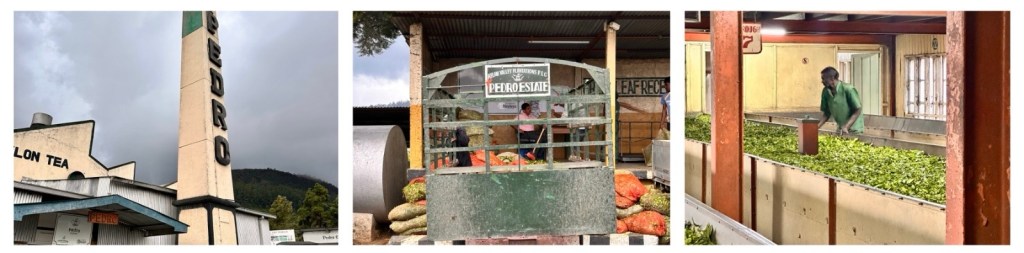
No trip to Sri Lanka is complete without a tea factory visit, so we stop at Pedro Tea Estate. The factory is in full swing — even on a Sunday. We get a short tour past bales of freshly picked leaves, drying ovens, and rattling grinding machines. The factory workers wear hairnets, but we wander in with muddy flip-flops and zero protection. Safety regulations seem to be taken rather lightly here.
The tour ends rather abruptly. We were supposed to be served tea, but after a long wait, we leave without it — we have a train to catch.
Along the way, the weather takes a turn. Heavy rain causes flooding, mudslides, and loose rocks. Ronnie skilfully navigates around deep puddles and minor landslides.
The Train from Nuwara Eliya to Ella
The little station is charming, and the platform is packed with tourists — more than we’ve seen together this whole trip. Once we’re on the train, the rain has mostly cleared. What follows is one of the most beautiful train journeys in the world. The train winds its way through the landscape at about 25 km/h: misty mountains, gentle streams and massive waterfalls, dense forests, endless tea fields. People wave from the side of the tracks. Other tourists lean out of the doors for the perfect photo. We stay seated — and take in the breathtaking scenery.
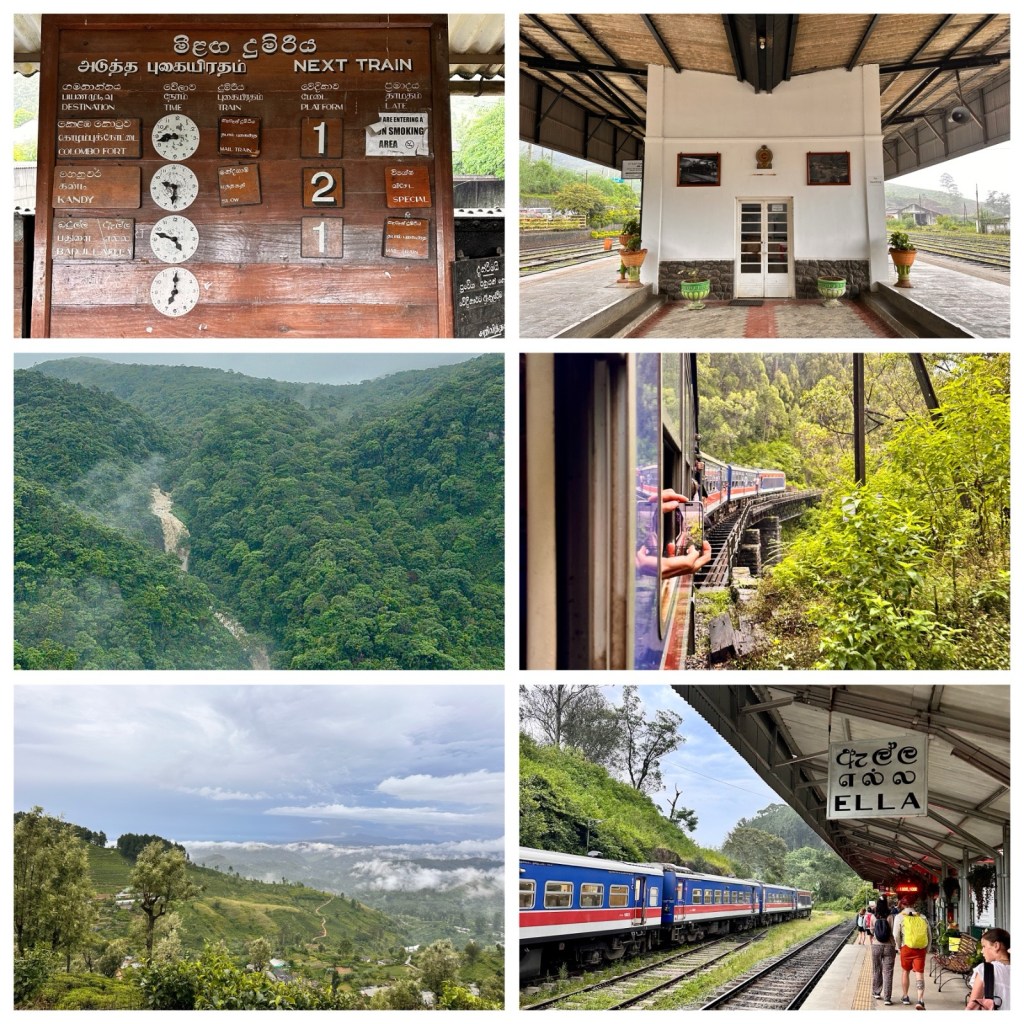
As dusk begins to fall, we arrive in Ella. After some initial confusion about our accommodation, we settle in a bit later than planned — but it’s worth the wait. Our spacious Jungle Suite is a delight, the shower is hot, and the service is impeccable.
Quick Facts:
- Nuwara Eliya sits at an altitude of 1,868 metres and has a cool, misty climate.
- The train ride from Nanu Oya to Ella takes about 3–4 hours and is considered one of the most beautiful in the world. You can also take it from Kandy — though that means spending a full day on the train.
- During the rainy season, roads can become difficult to navigate and trains may be delayed — with limited views along the way.
Accommodation in Ella: Ariana Eco Lodge Booked last minute and a great choice — 9/10 (though be prepared for lots of stairs, so it’s less suitable for those with limited mobility).
8. Ella & Surroundings
Ella is a lovely place to be — it’s somewhat reminiscent of a small-scale version of Ubud, but without the chaotic crowds (see also my blog: The Bali Vibe). The air is fresh, the atmosphere relaxed, and the views surrounding Ella — with jungle sounds and the constant murmur of a distant waterfall — feel like a gift.
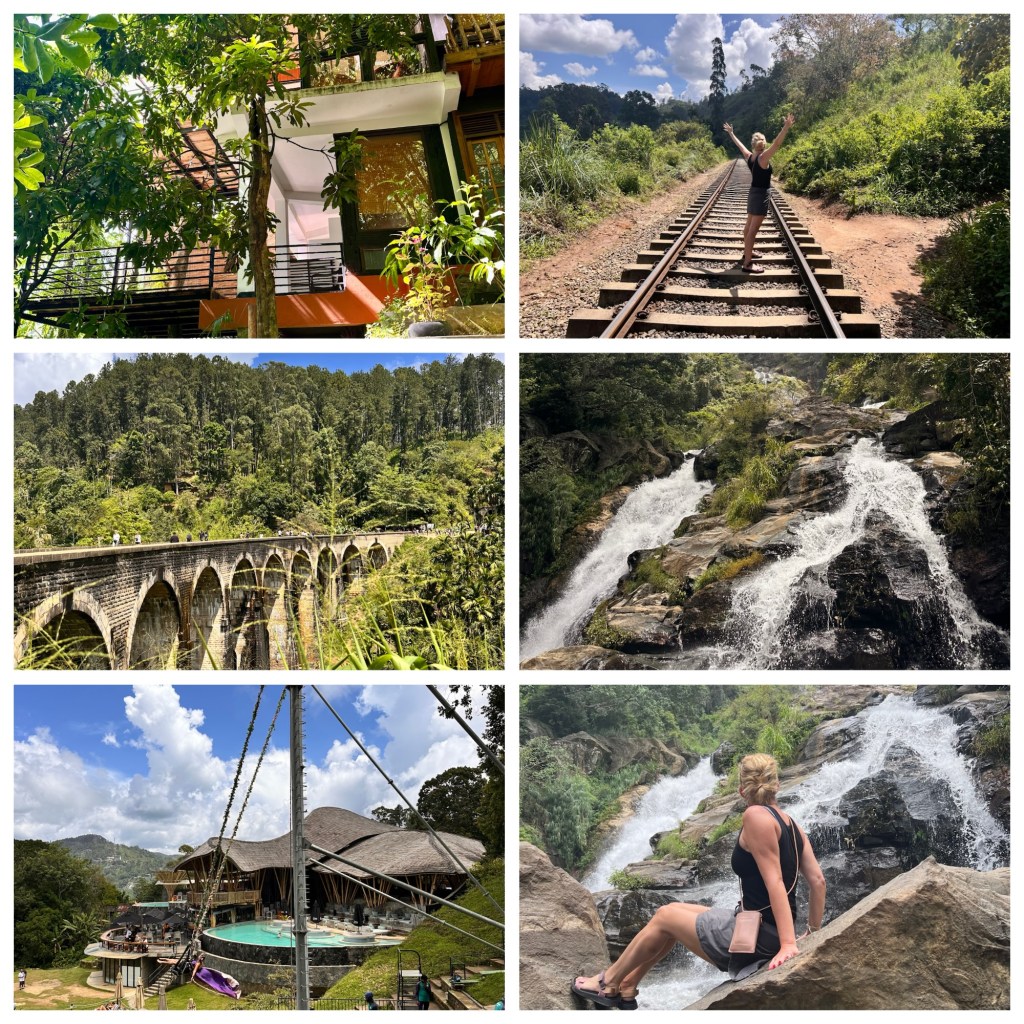
We set out to see the iconic Nine Arch Bridge up close. After a steep descent, we reach this stunning structure from the British colonial era, surrounded by lush jungle. The climb back up? We happily leave that to a tuk-tuk. It’s amazing how such a tiny vehicle can carry four adults uphill without breaking a sweat.
Next, we visit Mini Adam’s Peak. The climb is manageable, and the view is spectacular. Along the way, we pass a pool bar tucked between the rice fields and a giant swing — complete with flowing robes for the perfect Instagram shot. Once again, it brings Ubud to mind — something we hope won’t take over too much in this still unspoiled corner of Sri Lanka.
At the Ravana Falls, I give in: a charming little photo moment. With a hint of embarrassment — yes, even in my 50s, I’m doing this. But the water cascades down so beautifully, I simply can’t resist. Thankfully, no busloads of tourists or queues for a photo here.
Quick Facts
- Ella is a popular mountain village, loved for its hikes, scenic viewpoints, and laid-back atmosphere.
- The Nine Arch Bridge was built in 1921, entirely out of brick — without the use of steel.
- Ravana Falls is one of the most famous waterfalls in Sri Lanka — though there are plenty more to discover in the surrounding area.
Tip: Try Lamprais in Ella — a delicious local dish not to be missed.
9. Polhena at sea
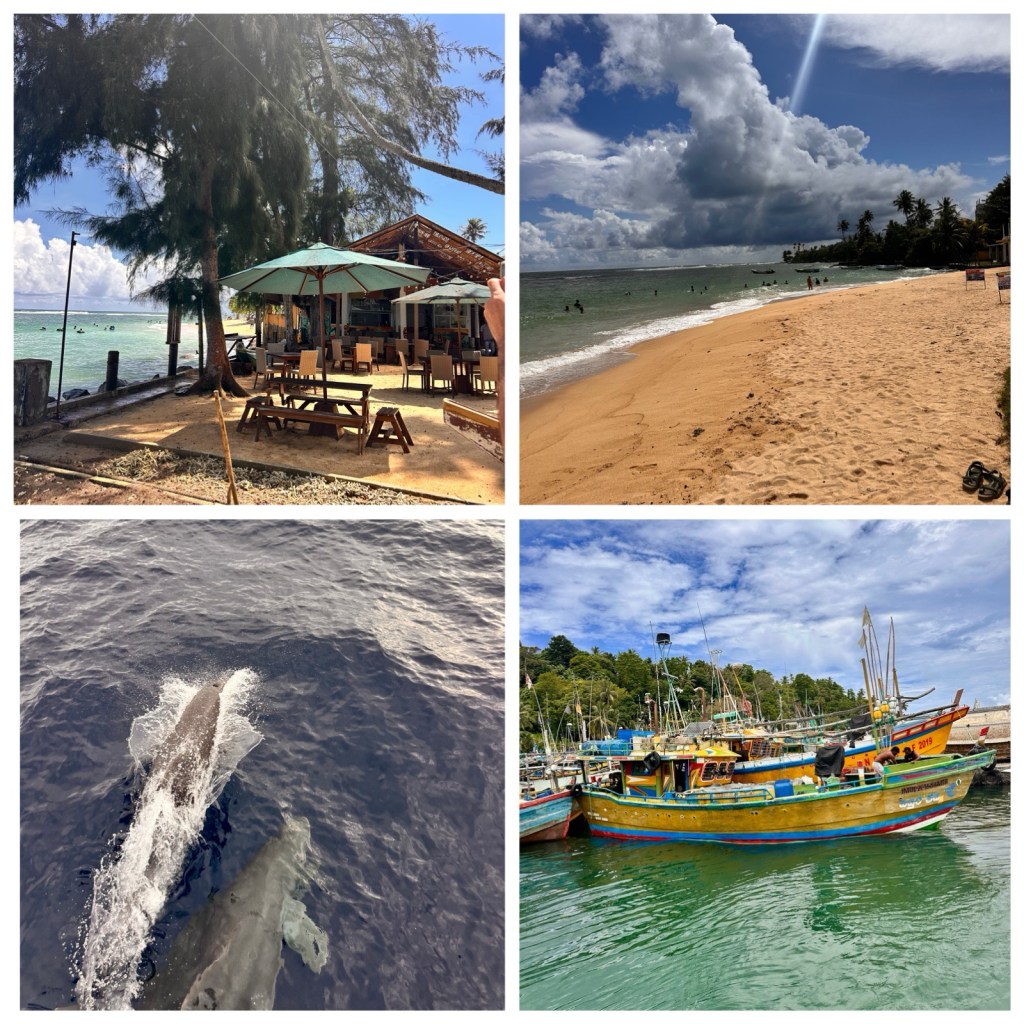
We arrive on the south coast, in Matara|Polhena. Our accommodation is within walking distance of the beach. We decide to trade a jungle trek through the rainforest for a relaxing day by the sea. Lunch with our feet in the sand, a beach bed to sink into, warm ocean water, and a gentle sun. A bit too gentle with the sunscreen though — by evening, we’re both rather red. Ouch.
Whale Watching tour
The next morning, the alarm goes off at 5 a.m. Time for action: whale watching. We’re given coffee and a seasickness pill — never a great sign. And yes, the sea is pretty rough, with heavy waves. But it’s all absolutely worth it.
After about an hour at sea, we spot a pod of dolphins. One of the crew suggests we move to the bow — a golden tip, because for several minutes, the dolphins swim beneath and alongside us. I could almost touch them. Graceful, joyful, magnificent. And then: a blue whale. At first just a spout of water, then part of its back. And more dolphins. We never imagined we’d see so much life out on the ocean. A magical trip.
Camp Coconut
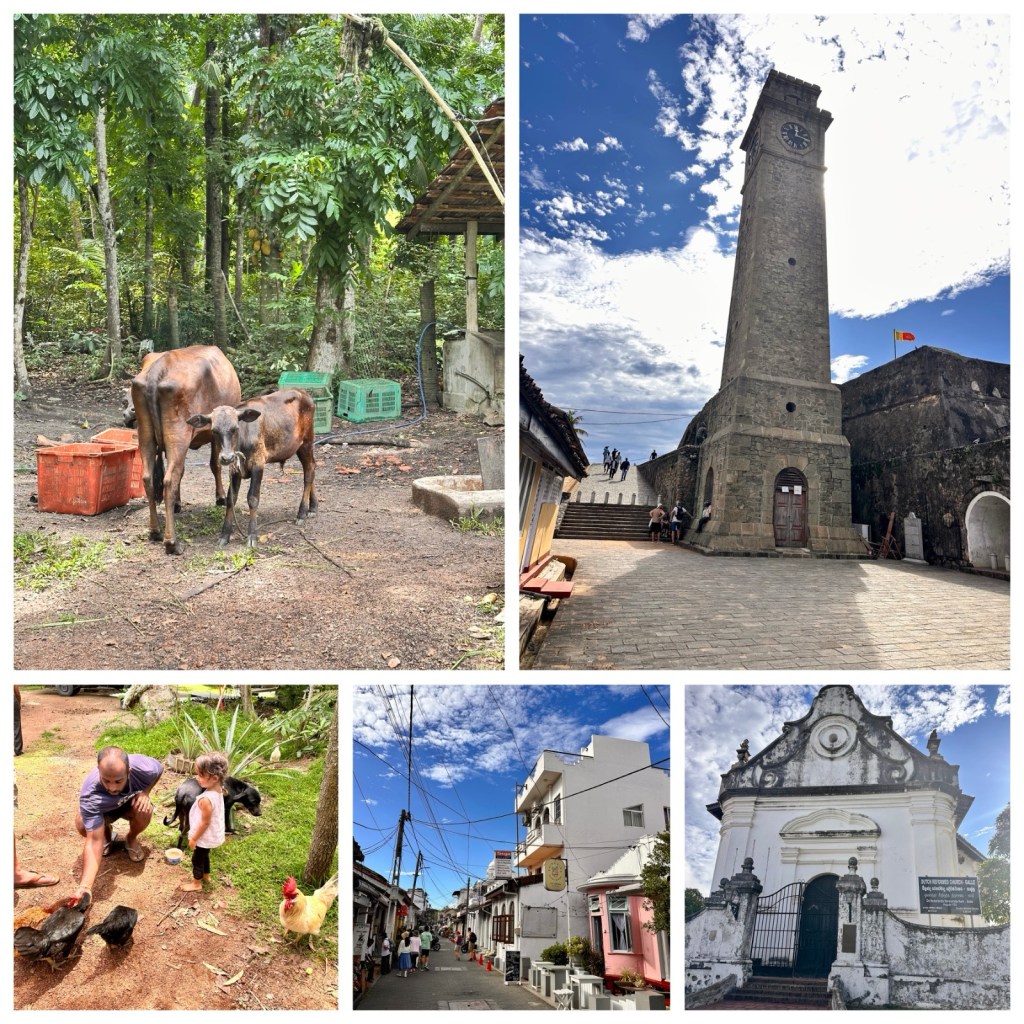
Back on land, we drive to an old colonial house where a German-Sri Lankan couple runs a sustainable farm — Camp Coconut — which also offers guest stays. We learn that pineapples don’t grow on trees, but low to the ground, sprouting from the top of another pineapple plant (ahem), and that it takes about two years for one to mature and become edible. We also see how they produce cooking gas from manure, and how Sri Lankan coconut sambal is made: fresh, spicy, and pounded on a stone. The couple’s little ones add an extra joyful and heartwarming touch to the visit. Lunch is delicious, and once again, it feels like we’re visiting friends.
The day isn’t over yet: we continue on to Galle. This charming city, surrounded by an old fort with Dutch roots, feels like a postcard. Narrow lanes, colonial influences, lovely little restaurants. We wouldn’t have minded spending a night here too. Who knows — maybe someday.
Snorkeling with Turtles
Our final morning by the sea begins in the water. With a snorkelling guide, we head out to the coral reef and spot the most beautiful fish — and, to our delight, sea turtles. They’re larger than I expected, graceful, with those gentle, wise-looking faces.
Colombo
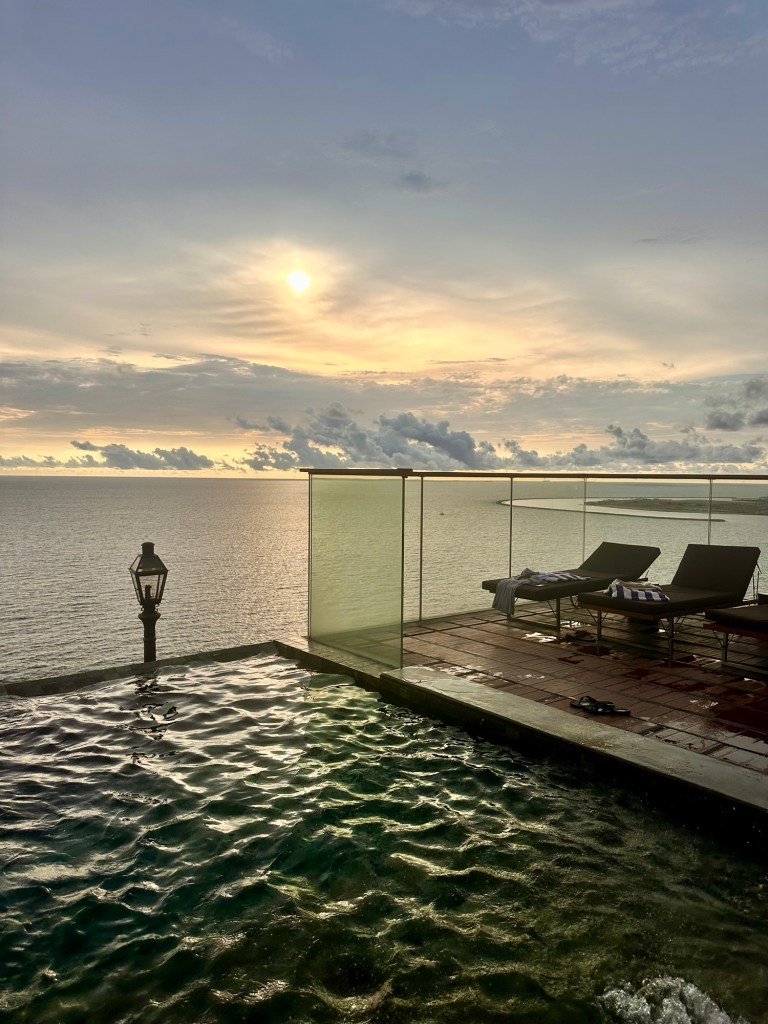
We leave early for Colombo. We skip the city itself — it’s hot, crowded, and our minds are already full from everything we’ve seen and experienced over the past two weeks. Luckily, the hotel is perfect: a rooftop terrace, an infinity pool, and a generous buffet — with a surprise: our table is decorated for a Farewell dinner. There are worse ways to say goodbye.
Is Colombo worth a visit? No idea. But Sri Lanka? 1000%!
Quick Facts
- Polhena is located on the south coast, near Matara. It’s known for its calm beach and resident turtle population.
- Whale watching is best from November to April — be sure to leave early.
- Galle is a charming colonial city with a well-preserved fort and strong Dutch influences.
Accommodations: Ananda Prana Polhena Simple seaside lodge — 8/10 on the basic scale (close to the beach, spacious rooms, friendly host, slightly cluttered surroundings, noisy, and the finish and cleanliness could be improved).
Last night in Colombo: Grandbell hotel with beautiful rooms and an infinity pool — 9/10 as a worthy grand finale.
To conclude
Sri Lanka has touched us.
What a beautiful country: so green, forested, clean, and well-kept. Everywhere you look, there are flowers, birds, rice fields, mountains, and coastlines — and amidst it all, the gentle nature of people who welcome you with open arms. It’s friendly, warm, and… surprisingly peaceful. Traveling without crowds or hustle, but with everything that makes a trip special.
We had our trip organized by a small local travel agency — and it certainly had its advantages. We visited places we likely wouldn’t have come across otherwise, spots that even large travel agencies often overlook.
The accommodations we stayed in were mostly basic and available to book at a low price (which, unfortunately, we didn’t pay). In that sense, it could have been more in line with our travel budget (see also: The Karen in me).
Sri Lanka, on of the most beautiful countries we have visited, will continue to travel with us for a while — in images, scents, conversations, and memories.
Thankfully, we still have the photos ❤️.
Hi! I’m Maaike — blogSter, mentor, expat, and founder of SingaporeandMe and SingaporeandYou.
In my weekly blog, I explore all the corners of my life as an expat, 50+ woman, mother, daughter, sister, long-distance friend, and former corporate director turned small-scale entrepreneur. Colourful, brutally honest, critical with a sense of humour — and above all, reflective.
Don’t want to miss a post?
Scroll down to subscribe and get my latest blogs straight to your inbox👇 or follow my insta
Curious about how to shape your own Singapore story? Have a look at our website and Instagram and discover what we have to offer here in Singapore.

 SingaporeandMe
Plaats een reactie